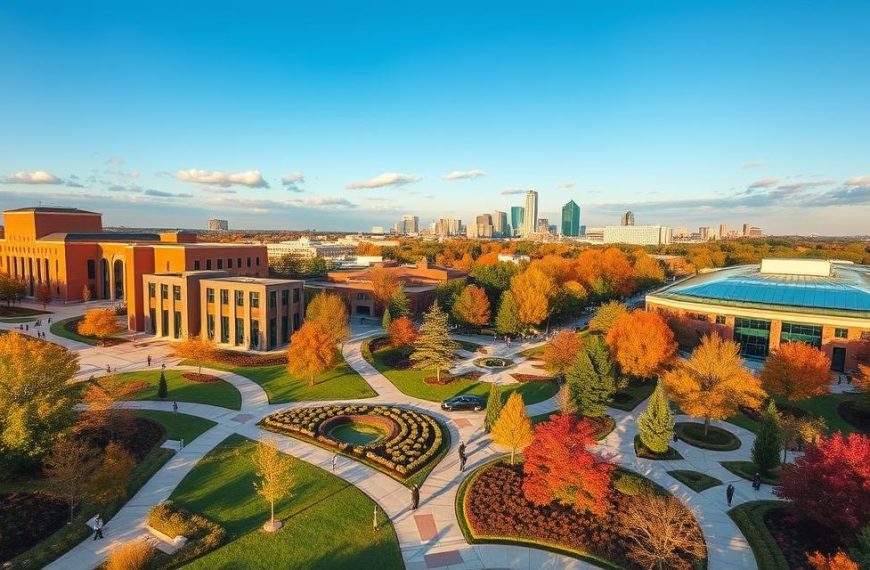
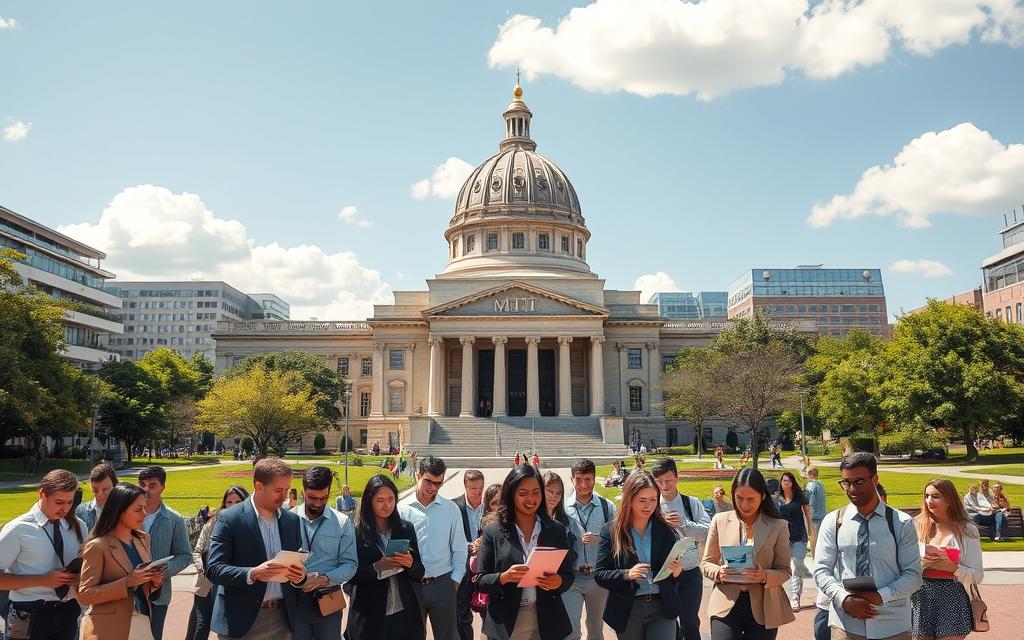

The Massachusetts Institute of Technology is a top name in education worldwide. It’s known for changing how we learn. This research university is a place where new ideas grow and subjects blend together.
MIT’s success comes from its amazing teachers. These experts are not just top in their fields but also love teaching. They share their latest research in class, making learning both theoretical and practical.
Students get a world-class education that prepares them for real challenges. MIT’s way of teaching breaks down old subject barriers. This encourages teamwork across different fields, just like solving today’s complex problems.
This special learning setting helps graduates become leaders. They have deep knowledge in their field and a wide view to make a difference in many areas.
The Historical Foundation of the Massachusetts Institute of Technology
Massachusetts Institute of Technology (MIT) has a remarkable story in higher education. It shows how a vision can grow into a global leader in education.
Origins and Founding Vision in 1861
William Barton Rogers founded MIT in America’s industrial revolution era. He wanted to mix scientific theory with practical lab work. This new approach challenged old education models.
The charter was approved on 10th April 1861, just before the Civil War started. Despite the chaos, Rogers kept his dream of a new kind of technical education alive. His Mens et Manus (Mind and Hand) motto guides MIT today.
Early courses focused on engineering, chemistry, and architecture. MIT’s focus on solving real problems set it apart from traditional universities. This foundation made MIT’s education unique.
Evolution Through the Twentieth Century
The twentieth century was a big time for MIT. In 1916, it moved from Boston to Cambridge, growing a lot. This move helped MIT grow in both size and courses.
World War II was a key moment for MIT. The Radiation Laboratory worked on radar, helping the Allies win. This work showed MIT’s ability to tackle big challenges through innovation.
After the war, MIT got more funding and grew its programs. It worked closely with government and industry. These partnerships boosted MIT’s research and education.
| Time Period | Key Developments | Leadership | Significance |
|---|---|---|---|
| 1861-1890 | Initial establishment, first classes | William Barton Rogers | Foundation of practical education model |
| 1916-1940 | Cambridge relocation, programme expansion | Richard Maclaurin | Physical and academic growth |
| 1940-1960 | Radiation Laboratory, federal research | Karl Compton | National research leadership established |
| 1960-2000 | Computing expansion, interdisciplinary programmes | Howard Johnson | Modern research university model developed |
Modern Era Developments and Expansions
Recently, MIT has embraced digital changes and global issues. It launched OpenCourseWare in 2001, making learning materials available worldwide. This shows MIT’s dedication to sharing knowledge.
In 2019, MIT started the Schwarzman College of Computing. It focuses on computing and AI, blending them with all subjects. This college shows MIT’s commitment to keeping up with technology.
MIT is also growing globally through partnerships and programs. It stays true to its founding values while facing today’s challenges. This ensures MIT remains a leader in tech education and research.
Today, MIT is building sustainably and creating new spaces for innovation. These efforts support its mission and show its commitment to the environment. MIT’s growth in buildings reflects its ambition in education.
Academic Organisation and Structural Framework
Massachusetts Institute of Technology (MIT) has a unique way of teaching. It mixes innovation and teamwork in its classes. This setup lets students dive deep into their subjects and explore other areas too.
Five Schools and One College Architecture
MIT is divided into five schools and one college. This structure is at the heart of the university. It includes:
- School of Architecture and Planning
- School of Engineering
- School of Humanities, Arts, and Social Sciences
- Sloan School of Management
- School of Science
- MIT Schwarzman College of Computing
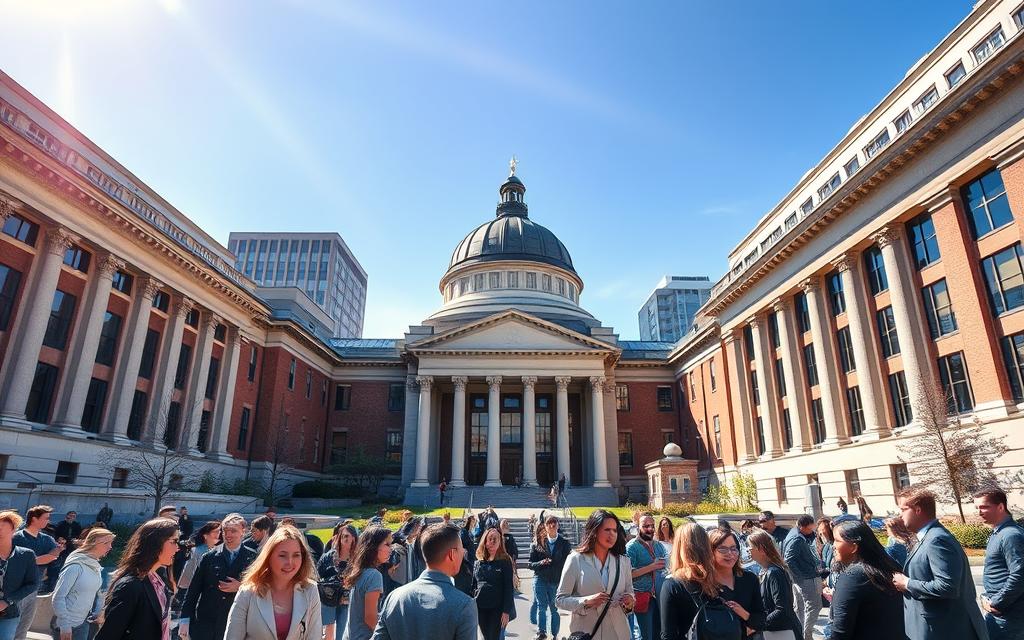
The MIT Schwarzman College of Computing is special. It links all five schools together. It helps students learn about digital technologies and computational thinking.
Interdisciplinary Programmes and Cross-Departmental Initiatives
MIT loves to mix different subjects in its research. It has many centres for this. Teachers work with different departments to tackle big problems.
There are over 60 research centres at MIT. They focus on things like clean energy, cancer, and the environment. They also look into artificial intelligence and urban planning.
These centres let students and researchers work together. They can share ideas from different fields. This way, they come up with new solutions.
Academic Calendar and Term Structure
MIT has a special calendar for its classes. It helps students learn deeply and explore different subjects. The year is divided into:
| Academic Period | Duration | Primary Focus |
|---|---|---|
| Fall Semester | September – December | Core curriculum and specialisation |
| Independent Activities Period (IAP) | January | Experimental learning and projects |
| Spring Semester | February – May | Advanced courses and research |
| Summer Term | June – August | Research opportunities and internships |
The Independent Activities Period is special. It’s a four-week time for students to do projects they love. They can take unusual courses or do research in areas they’re not usually in.
MIT’s flexible schedule fits its teaching style. It mixes learning with doing. The calendar helps students be creative while keeping high standards.
Undergraduate Educational Programmes
The undergraduate experience at MIT focuses on Bachelor of Science degrees in various fields. These programmes mix academic study with practical skills. This prepares students for careers and further research.
Bachelor of Science Degree Offerings
MIT’s undergraduate degrees cover many areas. Each programme aims to build deep knowledge and encourage thinking across disciplines. Students enjoy small classes, close mentorship, and access to modern facilities.
Engineering Disciplines and Specialisations
The School of Engineering has many specialisations, like mechanical and electrical engineering. These programmes focus on both theory and practical skills through labs and projects.
Iconic courses like 2.009 show this approach. Students design, invent, and apply their skills to real-world problems. This course highlights MIT’s focus on project-based learning in engineering.
Science and Mathematics Programmes
Science undergraduates can choose from physics, chemistry, biology, and earth sciences. Mathematics programmes include pure and applied maths, as well as computer science.
These programmes offer research chances from the start. Students work on major discoveries with faculty mentors. The curriculum balances specialisation with a broad scientific understanding.
The School of Architecture and Planning offers unique programmes in architecture, urban studies, and media arts. These programmes mix creative design with technical skills and social awareness.
Students tackle big challenges like sustainable development and digital media design. The curriculum combines studio work, technical courses, and humanities.
General Institute Requirements Curriculum
All undergraduates must complete the General Institute Requirements (GIRs). This ensures they get a broad education across disciplines. The foundation includes:
- Science core requirements in physics, chemistry, and biology
- Mathematics through multivariable calculus and differential equations
- Humanities, arts, and social sciences courses
- Communication-intensive requirements
- Laboratory and project-based experiences
The GIRs provide a common base while allowing for specialisation. This ensures graduates have both deep field knowledge and broad STEM knowledge.
This framework prepares MIT undergraduates for various careers and further study. The mix of specialisation and breadth is what makes MIT’s undergraduate education unique.
Graduate and Professional Education Opportunities
MIT is dedicated to advanced learning, beyond just undergraduate studies. It offers top-notch graduate studies and professional development paths. These are designed for different career stages and learning goals.

Research-Focused Doctoral Programmes
At MIT, doctoral students dive into cutting-edge research in various fields. These programmes focus on making new discoveries through in-depth research.
Students work with top faculty in leading labs and research centres. This experience prepares them for leading roles in academia, industry, and research globally.
Professional Master’s Programmes
MIT’s professional master’s programmes mix deep learning with real-world applications. They’re perfect for professionals looking to grow their skills while keeping their jobs.
Engineering and Technology Focused Programmes
These programmes cover the latest in AI, renewable energy, and advanced manufacturing. Students get hands-on with new tech and methods.
They include work with industry partners and real projects. This makes graduates highly sought after in many sectors.
Business and Management Programmes
These programmes focus on leading innovation and strategic thinking. They blend tech management with business basics.
Students learn to make decisions with data and lead organisations. These skills are essential for top roles in tech-driven companies.
Postdoctoral Research Opportunities
Postdoctoral positions at MIT offer advanced researchers a chance to deepen their knowledge. They contribute to groundbreaking research and start their own projects.
These roles are a step towards becoming a professor or research leader. Postdocs enjoy MIT’s collaborative research environment and vast resources.
For executives, managers, entrepreneurs, and tech pros, MIT has many executive and professional programmes. These range from short sessions to long programmes, online or on campus.
| Programme Type | Duration | Delivery Format | Primary Audience |
|---|---|---|---|
| Executive Education | 2 days – 2 weeks | On-campus/Online | Senior Professionals |
| Professional Master’s | 12-24 months | On-campus | Mid-career Professionals |
| Online Certificates | 3-6 months | Online | Working Professionals |
| Doctoral Programmes | 4-6 years | On-campus | Research-focused Students |
| Postdoctoral Research | 1-3 years | On-campus | Recent PhD Graduates |
Students can check out all graduate programmes at MIT’s Office of Graduate Education. MIT’s flexible approach to graduate studies helps professionals meet their career goals and schedules.
MIT supports professional development at every career stage. From new graduates to seasoned executives, there are paths for ongoing learning and growth.
Research Ecosystem and Innovation Culture
MIT’s research environment is a dynamic mix of theory and practice. It’s a place where new ideas come to life through teamwork across different fields. This culture of innovation is felt everywhere on campus.
Major Research Laboratories and Centres
MIT has many research facilities that lead innovation in various areas. These centres are key for cutting-edge research and teamwork.
The Institute’s research setup includes:
- Lincoln Laboratory – focused on national security technologies
- Koch Institute for Integrative Cancer Research – pioneering biomedical solutions
- Media Lab – exploring human-machine interaction and digital technologies
- Haystack Observatory – advancing radio astronomy and space research
These labs offer top-notch tools and resources. They help researchers explore new frontiers in their fields. The variety of labs offers unique chances for both teachers and students to research.
Undergraduate Research Opportunities Programme
The Undergraduate Research Opportunities Programme (UROP) is a key part of MIT’s learning approach. It lets students start real research projects from their first year.
UROP brings many benefits:
- Working closely with faculty mentors
- Joining ongoing research projects
- Getting academic credit or a stipend
- Presenting work at symposiums
UROP and other programmes like MISTI and D-Lab give undergrads valuable experience. This experience often leads to publications and patents.
Industry Collaboration and Technology Transfer
MIT works closely with industry leaders to turn research into practical solutions. The Technology Licensing Office handles intellectual property and helps start-ups.
Key ways of working together include:
- Research programmes sponsored by industry
- Joint research centres with companies
- Licensing agreements for technology transfer
- Support for entrepreneurship at the Martin Trust Center
These partnerships help MIT’s innovations reach the world. They also give students a chance to tackle real-world problems. This innovation culture is fueled by these connections, creating a path from lab to market.
MIT’s mix of academic excellence and practical innovation makes it a world leader in research and tech. Its focus on meaningful research opportunities keeps driving its impact in many areas.
Distinctive Pedagogical Approaches
MIT’s education goes beyond traditional teaching. It combines deep learning with real-world skills. This approach helps students grow intellectually and solve problems effectively.
Mens et Manus Educational Philosophy
The motto Mens et Manus (Mind and Hand) shows MIT’s focus on learning by doing. It’s at the heart of the institute’s teaching. Students learn both theory and practical skills.
They do lab work, field studies, and assignments. These activities help them understand and apply what they learn. It’s a hands-on way to learn.
Project-Based Learning Methodology
MIT uses project-based learning to tackle real challenges. This method boosts teamwork and critical thinking. It also prepares students for their future careers.
Students work on projects that mimic real-world scenarios. They learn to manage tasks, work in teams, and present their work. This prepares them for professional success.
The project-based learning method is used across many subjects. It helps students develop skills that are useful in many careers.
Digital Learning Initiatives and MITx Programmes
MIT leads in digital education with online platforms. The MITx programme and Open Learning show its commitment to sharing knowledge worldwide.
These platforms offer online courses that are as rigorous as on-campus classes. Students from all over the world can learn. They get to do virtual labs and complete assessments.
MIT Learn is a portal for non-degree learning. It offers certificates and short courses. It’s for professionals and anyone wanting to learn more.
MIT’s digital education includes:
- MIT OpenCourseWare providing free course materials
- MITx MicroMasters programmes for credentials
- Digital labs for remote experiments
- Online learning communities
| Platform | Primary Audience | Credential Offered | Learning Format |
|---|---|---|---|
| MIT OpenCourseWare | Self-directed learners | No formal credential | Asynchronous content access |
| MITx Courses | Professional learners | Digital certificates | Structured timeline with assessments |
| MITx MicroMasters | Career advancers | Stackable credentials | Series of graduate-level courses |
| MIT Learn | Professional development | Non-degree certificates | Flexible scheduling options |
These digital education efforts keep MIT’s high standards. They make quality learning available to more people. Technology helps make learning better without losing quality.
MIT’s teaching methods offer a unique learning experience. They mix theory, practice, and technology. This creates a learning environment that keeps improving.
Faculty Excellence and Academic Leadership
MIT’s top-notch faculty is key to its academic success. They are dedicated to teaching and research. Their work sets global standards in many fields.

Nobel Laureates and Distinguished Professors
MIT is proud of its Nobel laureate professors. They have won the Nobel Prize in various fields. This shows MIT’s commitment to excellence in research.
MIT also has many other top academics. They have won the Turing Award and other major honours. This talent creates a place where new ideas grow and people work together.
Student-Faculty Research Collaboration Models
MIT has special ways for students and professors to work together. The Undergraduate Research Opportunities Programme (UROP) is a great example. It lets undergrads join real research projects.
These partnerships go beyond school. Students often write papers with their professors. MIT supports these efforts with funding and programs.
Teaching Excellence and Innovation Awards
MIT gives awards for great teaching. The James R. Killian Jr. Faculty Achievement Award is one. It honours professors who do outstanding work.
There’s also the MIT Teaching with Digital Technology Awards. They celebrate using technology in teaching. These awards show MIT values both research and teaching.
MIT’s culture of excellence means students learn from leaders. These professors are shaping their fields and improving education.
Campus Infrastructure and Learning Resources
MIT’s campus is a place where ideas become real through advanced facilities. It supports learning from start to finish. This makes education practical and effective.
Library System and Digital Archives
The MIT Libraries have five main libraries and special collections. They hold over five million books and digital resources.
Students can find rare items, technical reports, and databases online. The archives are open 24/7 for academic journals and historical materials.
Librarians help with complex research. They offer personal support. This gives students access to knowledge worldwide.
Laboratory Facilities and Technical Resources
MIT’s labs are among the best in the world. They cover areas from nanotechnology to urban planning. There are over 200 labs on campus.
Places like the Wright Brothers Wind Tunnel and the MIT Nuclear Reactor Laboratory are available. The glass lab is for materials science experiments.
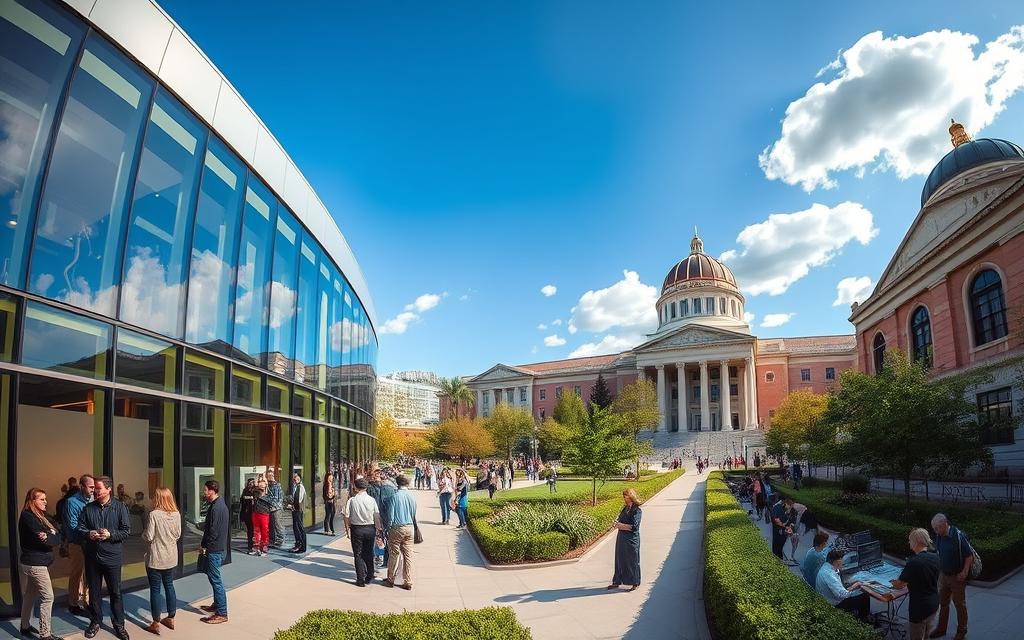
These resources are for both basic and applied research. Undergrads can use equipment usually for grad students elsewhere.
Innovation Spaces and Makerspaces
MIT follows mens et manus (mind and hand) with many makerspaces. These spaces have tools and help for making things real.
Students use 3D printers, laser cutters, and more. The MIT Hobby Shop has top woodworking and metalworking tools.
These places foster teamwork and new ideas. Many startups start here with prototypes.
MIT’s setup offers unique learning and innovation chances. It keeps updating to lead in tech education and research.
Student Development and Campus Life
MIT goes beyond just books and lectures. It focuses on making students well-rounded through various programmes. These efforts help shape future leaders.
The university’s dedication to student life is clear. It offers experiences that go beyond the classroom. These experiences are key to a student’s growth.
Extracurricular Activities and Student Societies
MIT has over 500 student groups. These groups help students grow and develop new skills. They range from cultural clubs to tech clubs.
Programmes like UROP and UPOP let students work on projects outside class. This way, they can apply what they learn in real situations.
Entrepreneurship Ecosystem and MIT $100K Competition
MIT is all about innovation and entrepreneurship. The famous MIT $100K Competition has helped many startups. It offers students a chance to get funding and advice.

There are also programmes like Sandbox Innovation Fund. They help turn ideas into businesses. This makes MIT a top place for innovation.
Global Opportunities and Study Abroad Programmes
MIT offers students a chance to see the world through programmes like MISTI. Students learn about different cultures and tackle global issues.
The Division of Student Life supports these experiences. It helps students grow both personally and professionally. These experiences prepare them for the world.
Admissions Process and Selection Criteria
Getting into MIT is a big deal for students all over the world. The school is very picky about who gets in. They look at how well you do in school, but also at your personality and what you can bring to the MIT community.
Undergraduate Admissions Requirements and Process
Applying to be an undergraduate at MIT is a big job. They want to see if you’re smart, creative, and can work well with others. It’s not just about your grades.
The application has a few key parts:
- Academic transcripts showing you’ve taken tough classes
- Standardised test scores (SAT or ACT)
- Teacher feedback on how you’ve done in class
- Personal essays that show who you are
- Proof of any extra activities or leadership roles
Admissions officers carefully check each application. They look for students who are not just book-smart but also have a spark. They want to know if you can handle MIT’s tough classes.
Graduate Programmes Selection Criteria
For graduate school, each department has its own rules. They look at your research skills, how well you’ve done in school, and if you fit with their area of study.
Here’s what you usually need for graduate school:
- Records from your undergraduate studies
- GRE scores, if needed
- A statement of why you want to do research
- Letters of recommendation from teachers
- Writing samples or portfolios for some fields
Some programs also have interviews. They want to see if you’re a good fit for their research and lab work. They look for students who know what they want to do and can make a real contribution.
Financial Aid and Scholarship Opportunities
MIT wants to make sure everyone can go to school, no matter their background. They don’t look at your financial situation when deciding if you can come. They make sure you can afford it if you get in.
Financial aid can come from a few places:
- MIT scholarships based on need
- Grants from the government and your state
- Jobs on campus to help pay for school
- Loans with good terms
To see if you qualify for financial aid, you need to fill out the CSS Profile and FAFSA. There are also scholarships for students who do well, but most help comes from need-based aid.
MIT really wants to make sure money doesn’t stop you from coming. They have a team to help you figure out how to pay for school. They want to make sure everyone has a chance to go to MIT.
Global Impact and Alumni Achievements
The Massachusetts Institute of Technology (MIT) has a big impact worldwide. It has a strong alumni network and runs global initiatives. Its graduates change industries and solve big problems.
Notable Alumni Contributions and Innovations
MIT’s alumni have changed our lives with their inventions. Without them, we wouldn’t have many important technologies today.
Here are some big contributions from MIT graduates:
- Radar technology that helped secure Allied victory in World War II
- Email systems that revolutionised global communication
- CT scanners that transformed medical diagnostics
- GPS technology that redefined navigation worldwide
- Time-release medications that improved pharmaceutical treatments
MIT’s alumni are also big entrepreneurs. They have started over 30,000 companies. These companies employ millions and make about $2 trillion a year.
International Research Collaborations
MIT works with partners all over the world. They tackle big challenges together.
MIT has research partnerships in over 90 countries. They work on issues like climate change, health, and sustainable development.
| Collaboration Type | Geographic Reach | Primary Focus Areas |
|---|---|---|
| Joint Research Centres | 25+ countries | Renewable energy, artificial intelligence |
| Faculty Exchange Programmes | 40+ countries | Biotechnology, urban planning |
| Global Research Consortia | Worldwide | Climate solutions, pandemic preparedness |
These partnerships show MIT’s dedication to sharing knowledge worldwide. Working together brings different views to research.
MIT’s Global Educational Initiatives
MIT also teaches people all over the world. They offer programs that make learning easy for everyone.
The MITx program lets millions of students learn online. Professional courses are available in over 150 countries.
MIT’s educational partnerships include:
- Collaborative degree programs with top universities
- Executive education courses for specific needs
- Open courseware for free learning worldwide
- Seed funding for educational startups in developing areas
These efforts create a global learning community. MIT’s teaching philosophy, “mens et manus,” influences education everywhere.
MIT’s impact keeps growing through these efforts. They are dedicated to solving world problems through education, innovation, and teamwork.
Conclusion
The Massachusetts Institute of Technology is a top example of educational excellence. It leads in science, technology, and more. It mixes tough academic work with hands-on learning, readying students for big challenges.
MIT’s influence goes far beyond its campus. It shapes industries and societies around the world. It tackles big issues like climate change and artificial intelligence through research and teamwork.
MIT offers a wide range of programs and has top-notch teachers. It creates a space where students can explore, think deeply, and solve problems. This helps students grow and learn a lot.
MIT stays ahead by working with businesses and governments. These partnerships help turn research into things that help people. This is how MIT makes a real difference.
Those looking to study or research at MIT find a place that supports their dreams. It attracts people who want to change the world through science and more.
MIT’s history of excellence and leadership means it stays important in a changing world. It keeps working to find answers to big problems. This is its promise to humanity.
FAQ
What undergraduate degrees does MIT offer?
MIT offers Bachelor of Science degrees in many areas. These include engineering, science, mathematics, architecture, and planning. The programmes give students a solid foundation and specialisation, preparing them for careers and further study.
How does MIT support interdisciplinary research and collaboration?
MIT has a structure that encourages teamwork across different fields. It has five schools and one college, including the MIT Schwarzman College of Computing. This setup helps students and faculty work together on big challenges, like clean energy and cancer research.
What is the Mens et Manus philosophy at MIT?
Mens et Manus means “Mind and Hand” at MIT. It’s about learning theory and applying it in practice. This is seen in project-based courses and hands-on challenges like 2.009, helping students solve real-world problems.
Are there opportunities for undergraduate research at MIT?
Yes, MIT’s Undergraduate Research Opportunities Programme (UROP) lets students start research early. UROP and other projects give undergrads a chance to work with faculty on cutting-edge projects.
What financial aid options are available for students?
MIT makes education accessible by meeting full financial need of all admitted undergrads. It offers scholarships, grants, and other aid to help students, ensuring money doesn’t stop them from attending.
How does MIT incorporate digital and online learning?
MIT uses digital learning to reach more people. It has MITx and Open Learning, which offer online courses worldwide. These platforms show MIT’s commitment to new teaching methods and sharing knowledge globally.
What distinguishes MIT’s graduate and professional programmes?
MIT’s graduate and professional programmes are deep and practical. They include research doctorates, professional master’s degrees, and executive education. Many are online, helping learners advance their careers with MIT’s latest research and expertise.
Can students participate in global opportunities while at MIT?
Absolutely. MISTI (MIT International Science and Technology Initiatives) offers study, research, and internships abroad. These experiences help students learn about different cultures and prepare for global leadership.
What resources are available to support innovation and entrepreneurship?
MIT has many resources for innovation and entrepreneurship. It has makerspaces, the MIT 0K Entrepreneurship Competition, and lots of industry partnerships. These help students turn ideas into real ventures and products.
How does MIT’s faculty contribute to its academic excellence?
MIT’s faculty includes Nobel laureates and top educators. They work with students on research, innovate teaching, and mentor. Their work supports MIT’s high standards in education and research.


 By
By

 By
By